
Key takeaways
- ✓ Yes, you can use FMLA for rehab — up to 12 weeks of unpaid, job-protected leave per year (29 USC 2612).
- ✓ Your position, pay grade, and health insurance are legally preserved during the leave.
- ⚠ Your employer must be covered by FMLA (50+ employees within 75 miles) and you must have worked 1,250 hours in the past 12 months.
- ⚠ FMLA covers treatment, not the addiction itself — a workplace zero-tolerance policy can still apply to prior incidents of impairment on the job.
- ✓ You do not have to disclose "addiction" by name — only that you have a serious health condition certified by a provider.
The short answer: federal law lets you take up to 12 weeks of unpaid, job-protected leave to attend inpatient, residential, or outpatient addiction treatment — but only if your employer is covered by the Family and Medical Leave Act (FMLA) and you meet the eligibility rules. When used correctly, FMLA preserves your position, health insurance, and seniority. Used incorrectly — or without understanding the narrow exceptions — you can still be terminated for workplace conduct that happened before your leave began. This guide walks through exactly how it works, who qualifies, how to request it, and what to do if your employer pushes back. If you're still in the earlier stage of deciding which program is right, start with our 12-point checklist for choosing a rehab center.
Can you actually take FMLA leave to go to rehab?
Yes. The Family and Medical Leave Act allows eligible employees of covered employers up to 12 weeks of unpaid leave per 12-month period for a "serious health condition" that prevents them from performing essential job functions. The U.S. Department of Labor has explicitly confirmed that substance use treatment qualifies when it meets two criteria:
- The treatment is provided by a licensed healthcare provider (physician, nurse practitioner, licensed mental health professional, or a provider at an approved facility); and
- The underlying condition meets the FMLA definition of a "serious health condition" — typically requiring inpatient care or continuing treatment by a provider.
Inpatient detox and residential treatment almost always qualify. Intensive outpatient (IOP) and partial hospitalization (PHP) usually qualify when they involve ongoing supervision by a provider. Standard outpatient counseling may qualify depending on frequency and documentation — ask your provider to certify this in writing. Not sure what level of care you'd need? Read our overview of the 6 stages of addiction recovery to see how inpatient, PHP, and IOP fit into a full treatment arc.
Who qualifies for FMLA (and who doesn't)?
\n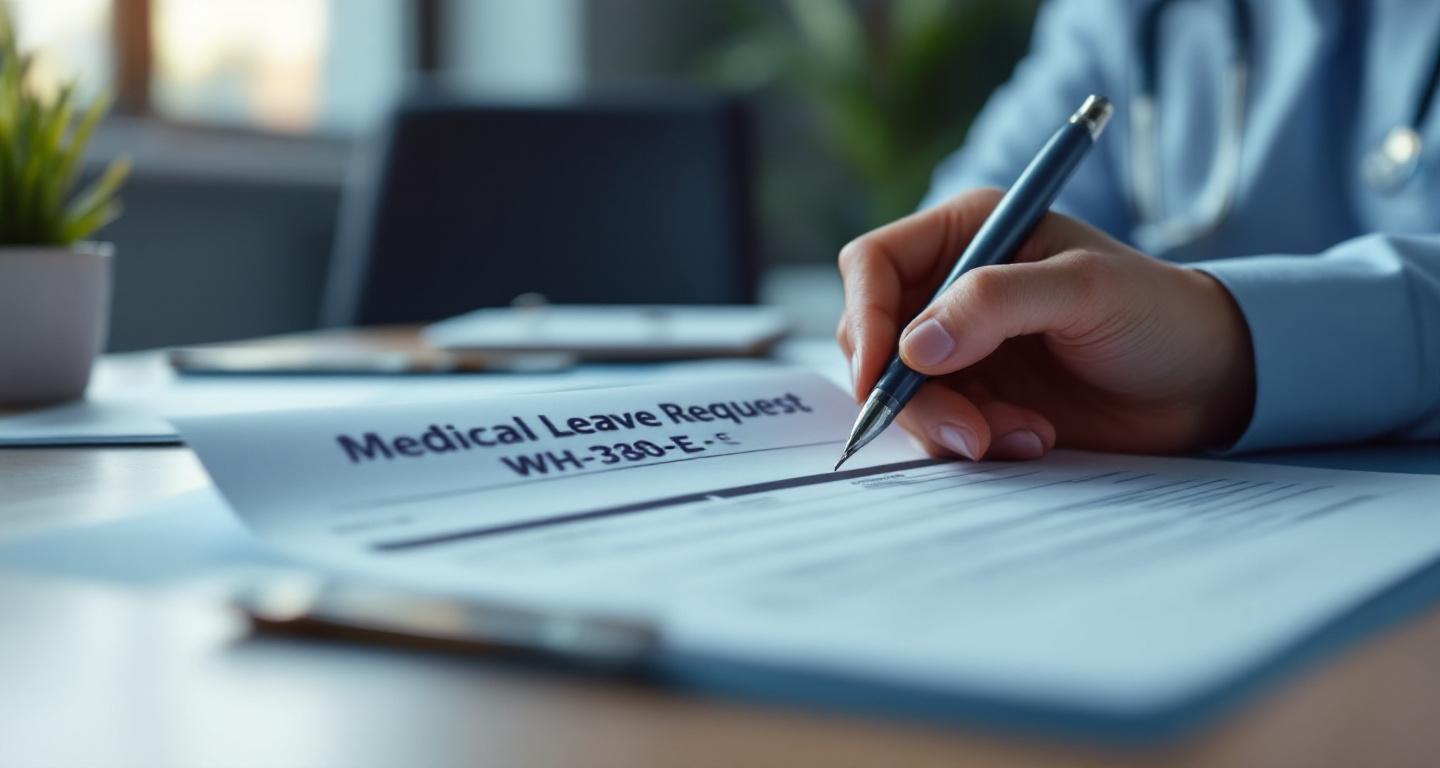 \n
\nFMLA requires a medical certification form (WH-380-E). Your provider completes it without disclosing the specific diagnosis.
\nThree conditions must all be true for FMLA to apply:
- Your employer is covered. FMLA applies to private employers with 50 or more employees within a 75-mile radius, plus all public agencies and most public/private elementary and secondary schools (regardless of size). Small businesses below the threshold are not required to offer FMLA.
- You have enough tenure. You must have worked for the employer for at least 12 months total (not necessarily consecutive) and logged at least 1,250 hours in the past 12 months (about 24 hours/week).
- You have a qualifying condition. A licensed provider must certify that you have a serious health condition — addiction, when being treated, qualifies. If the idea of "addiction as a medical condition" still feels unfamiliar, we address this in our piece on common rehab myths debunked with real data.
If your employer is smaller than 50 employees, FMLA does not apply — but the Americans with Disabilities Act (ADA) may. The ADA treats active addiction to illegal drugs differently from alcoholism, but people in recovery or actively in treatment are protected as having a disability if the employer has 15+ employees. That can mean a reasonable accommodation — often unpaid leave — even when FMLA doesn't apply.
Does rehab count as a "serious health condition"?
Yes, when certified. FMLA regulations (29 CFR Part 825) define a serious health condition as one requiring inpatient care, continuing treatment by a healthcare provider, or a chronic condition that requires periodic visits. Substance use disorder (SUD) fits all three patterns:
- Inpatient care — medical detox or residential rehab
- Continuing treatment — IOP, PHP, or medication-assisted treatment (MAT) over an extended period
- Chronic condition — recognized by the DSM-5 and major medical bodies as a chronic, relapsing disease. Peer-support frameworks like the 12-step approach are built around this chronic-disease understanding.
Your provider documents this on the standard FMLA medical certification form (WH-380-E for your own condition). See the DOL form library for current versions.
How much time off can you take for rehab under FMLA?
Up to 12 workweeks in a 12-month period, total across all FMLA reasons. That's enough to cover:
\n \n
\nFMLA guarantees your right to return to the same or equivalent position after treatment leave.
\n- 3–7 days of medical detox
- 28–90 days of inpatient or residential treatment
- Step-down to PHP or IOP on a reduced schedule
You can take FMLA as continuous leave (all at once) or as intermittent/reduced-schedule leave — for example, leaving early on therapy days. Intermittent leave is allowed when "medically necessary," which your provider certifies. If you've already used FMLA this year for another reason (parental leave, caring for a family member), your rehab leave is capped at whatever's left of the 12 weeks. Recovery often doesn't end with the 28- or 90-day window either — support from family therapy and nutrition-informed care typically extends well beyond initial treatment.
Does your employer have to know it's addiction treatment?
No. You are not required to disclose the specific diagnosis. The FMLA medical certification form asks about:
- The nature of the condition (in general terms)
- The expected duration of treatment
- Whether you can perform essential job functions
- Whether leave is needed continuously or intermittently
Your provider can list "serious health condition requiring inpatient treatment" without naming substance use disorder. Your employer's HR department may request this certification but cannot demand detailed medical records. They can require a second or third opinion at their expense if they doubt the certification.
Separately, federal law provides strong confidentiality protections. 42 CFR Part 2 — the federal regulation governing substance use treatment records — prevents your rehab facility from releasing information to your employer without your written consent. That's stricter than HIPAA. We explain how this works in practice on our editorial policy page and in every facility listing's Frequently Asked Questions section.
Can you be fired for going to rehab?
Not for taking FMLA leave itself — doing so is illegal retaliation. But FMLA protects your leave, not your prior conduct. A few important nuances:
- Past conduct while impaired on the job — coming to work under the influence, failing a drug test, safety violations — can still be disciplined under the employer's existing policy, even if you subsequently request FMLA. Employers are allowed to enforce a uniformly applied drug and alcohol policy.
- "Last chance agreements" — if your employer previously gave you an ultimatum linking rehab to continued employment, the terms of that agreement apply.
- Drug testing policies — employers can continue to test, and a positive test can be grounds for discipline. Being in treatment does not immunize future positive tests.
- Job elimination — if your position would have been eliminated anyway (layoff, restructuring), FMLA does not guarantee the job. But the employer must prove the decision was independent of your leave.
What you are protected from: being fired, demoted, or having your insurance dropped because you took FMLA leave. Courts have consistently ruled against employers who retaliate.
What if your employer isn't covered by FMLA?
You still have options:
- Americans with Disabilities Act (ADA) — for employers with 15+ employees. A reasonable accommodation can include unpaid leave for treatment. Request this in writing as "reasonable accommodation for a disability under the ADA."
- State family/medical leave laws — many states (California CFRA, New York PFL, Washington, New Jersey, Oregon, Massachusetts, Connecticut, and others) have their own leave laws, some stronger than FMLA. Check your state's labor department. You can also see how treatment access differs by state on our state directory.
- Short-term disability insurance — if you or your employer have STD coverage, addiction treatment may qualify for partial wage replacement. Check the policy's pre-existing condition and exclusion language.
- PTO / sick leave — negotiate using accumulated paid time off to cover treatment.
- Employee Assistance Program (EAP) — most mid-to-large employers have confidential EAPs that can help coordinate leave and find treatment.
If none of these apply, you're still protected from discrimination under state addiction-recovery laws in many states, and you may still be eligible for Medicaid-covered rehab in your state or SAMHSA-funded treatment centers.
Step-by-step: how to request FMLA leave for rehab
- Confirm eligibility privately first. Check your employee handbook or ask HR for FMLA eligibility without disclosing the reason: "Am I FMLA-eligible?" Your 1,250 hours and 12 months of tenure can be verified without revealing why you're asking.
- Get an assessment and pick a facility. Most programs can admit within 24–72 hours. Use our 50-state directory or full facility search to compare SAMHSA-verified centers — or call our free 24/7 helpline if you need help choosing. Our 12-point checklist covers what to ask each program.
- Give your employer 30 days' notice if leave is foreseeable — or as soon as practicable (typically within 1–2 business days) if it's not. For emergency detox, "as soon as practicable" applies.
- Submit the FMLA request in writing. Include expected start/end dates and that you'll provide medical certification. Do not voluntarily disclose substance use — HR only needs to know it's a serious health condition.
- Have your provider complete form WH-380-E (employee's own condition) and submit to HR within 15 calendar days. Keep a copy.
- Get written confirmation from HR that your leave is approved as FMLA-protected. This is essential if issues arise later.
- Continue paying your share of health insurance premiums. Coverage continues during FMLA, but your portion of the premium doesn't disappear. Ask HR how to pay while on leave.
- Stay in contact per company policy — check in on the schedule specified in your FMLA approval letter, not more often.
What to do if your employer denies leave or retaliates
- Document everything. Keep copies of your request, medical certification, HR responses, and any changes to your schedule, pay, or duties after you requested leave.
- File a complaint with the DOL Wage and Hour Division — it's free and can be done online at dol.gov/whd. The WHD investigates FMLA violations.
- File an EEOC charge if the issue is disability-based — addiction in recovery is a protected disability under the ADA. EEOC has a 180-day filing deadline from the date of the violation (300 days in some states).
- Consult an employment attorney. Most offer free initial consultations and work on contingency for retaliation cases. The National Employment Lawyers Association (NELA) has a directory.
- Know your state protections. Some states (California, New York, New Jersey) have stronger anti-retaliation laws and higher damage awards than federal law. Browse our California, New York, or all 50 state pages for specifics.
FMLA isn't perfect — the 50-employee threshold leaves out millions of workers, and unpaid leave is financially out of reach for many — but when it applies, it's a powerful tool. Combined with the ADA, 42 CFR Part 2 confidentiality protections, and state laws, most employed Americans have more job security during rehab than they realize. The key is knowing your rights, following the process in writing, and asking for help when needed.
Related guides to read next
Continue building your plan with these companion articles and tools.
Treatment guide
How to Choose a Rehab Center: 12-Point Checklist
What to ask each program, accreditation to look for, red flags to avoid.
Recovery
The 6 Stages of Addiction Recovery
Full timeline from pre-contemplation through long-term maintenance.
Family support
Family Therapy for Addiction: How It Works
Evidence-based family involvement during and after treatment.
Education
10 Common Rehab Myths Debunked
Research-backed reality check on willpower, relapse, and stigma.
Directory
Find a SAMHSA-Verified Center in Your State
Browse 23,000+ licensed treatment facilities across all 50 states.
MAT directory
Medication-Assisted Treatment Programs
Centers offering buprenorphine, methadone, and naltrexone.
Frequently asked questions about FMLA and rehab
Can I use vacation or sick time and FMLA at the same time?
Does FMLA cover the cost of rehab?
What if I need to come back to work before my treatment is fully done?
Does FMLA protect me if I relapse after returning to work?
Can my employer require me to enter rehab as a condition of keeping my job?
Are federal employees covered by FMLA for rehab?
What if I'm a new hire with less than 12 months tenure?
Does FMLA cover support groups like AA or NA?
Can I use FMLA to care for a family member in rehab?
Where can I find programs that fit my FMLA timeframe?
Sources & legal references
- 29 USC § 2612 — Family and Medical Leave Act, entitlement to leave. DOL FMLA portal.
- 29 CFR Part 825 — FMLA regulations. eCFR.gov.
- Form WH-380-E — Certification of Health Care Provider for Employee's Serious Health Condition. DOL forms.
- ADA & Addiction — EEOC guidance on disability rights for people in recovery. eeoc.gov/laws/guidance.
- 42 CFR Part 2 — Confidentiality of Substance Use Disorder Patient Records. SAMHSA.
- SAMHSA NSDUH 2023 — National Survey on Drug Use and Health data on treatment access.
- DOL Wage and Hour Division — file complaints at dol.gov/whd.
This article is informational and not legal advice. Laws vary by state and change periodically. Consult an employment attorney for advice on your specific situation. Last reviewed: April 2026 by the RehabPulse Editorial Team.